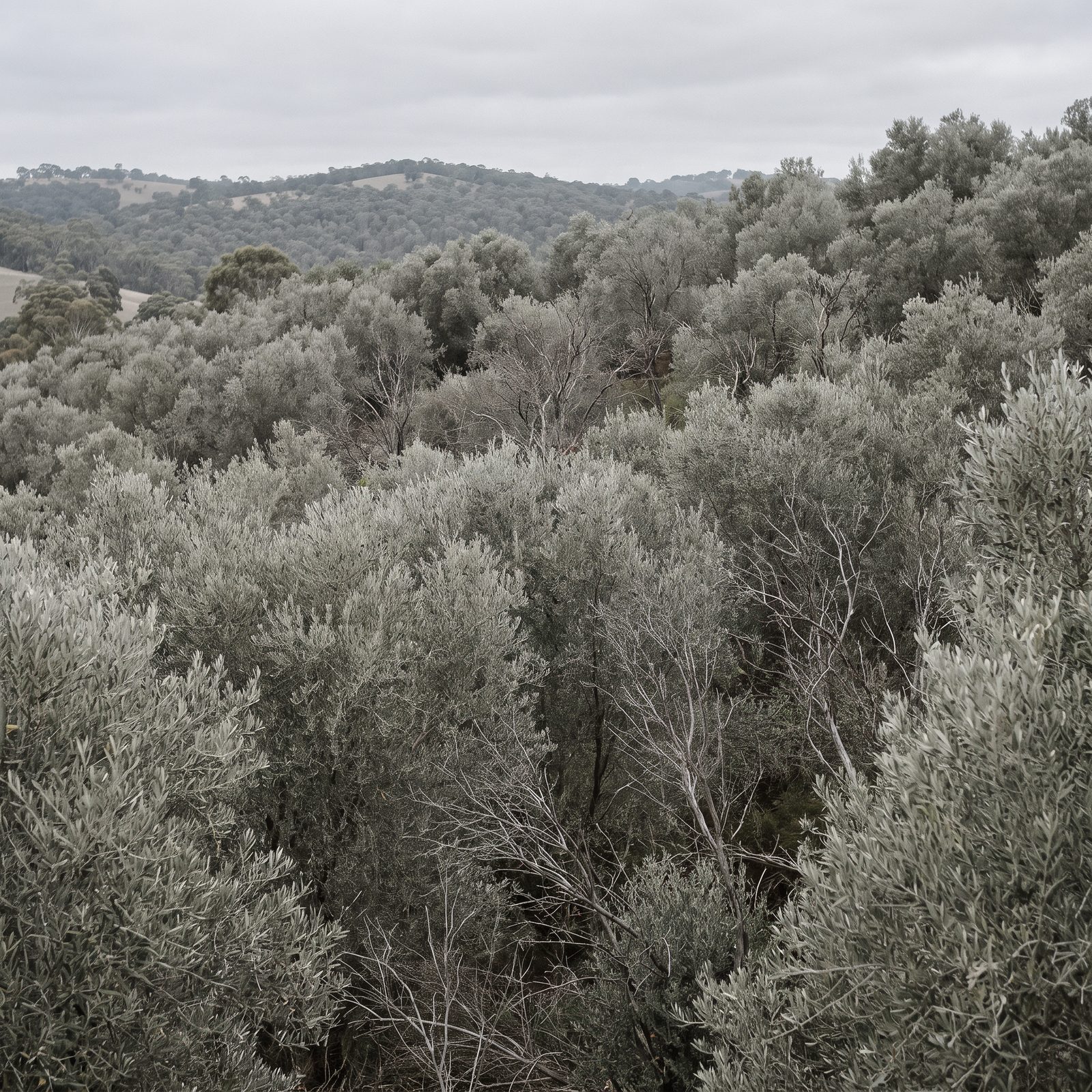
Feral olive is the single biggest structural problem on the land, and a legal obligation to control.
It forms a closed mid-canopy over as much as 80% crown cover, shading out native grasses, herbs and gum seedlings, so the gums above it become the last generation. It is spread by birds and by foxes, which carry the seed far from the parent tree. It also builds a continuous ladder of fuel from the ground into the tree crowns, so a fire that would have stayed low in the grass can climb into the canopy. In a gully that funnels fire uphill, that matters even more.
Stem injection (drill and fill), a minimal-disturbance method that kills the tree in place with no soil damage and no machinery, so seed is not spread. On the land this is led by Danny Rohrlach of Minimal Disturbance Bushcare. Controlling olive is a legal obligation under the Landscape South Australia Act 2019, not a choice.
Extensive through the gully and scattered across the slopes.
Look up control: Green Adelaide weeds.
The top-priority weed at Skye. Clearing it lowers the bushfire risk and lets the old gums recover.